
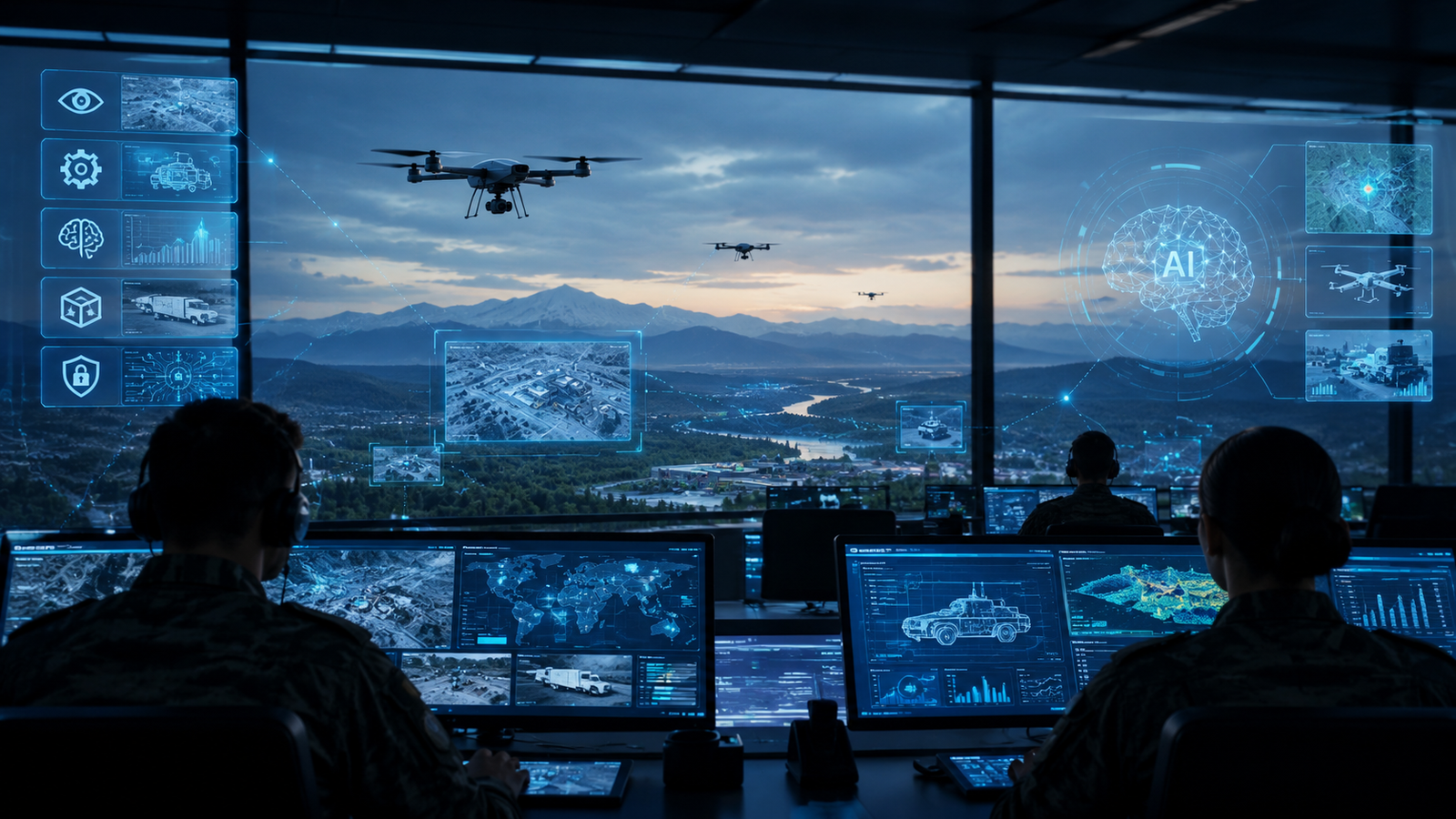
Artificial Intelligence (AI) is becoming an important part of modern defence technology. From analysing surveillance data to supporting predictive maintenance and simulation-based training, AI is creating new ways to process information, improve engineering workflows and support informed decision-making.
As defence environments become more digitally connected, organisations are exploring how AI can work alongside sensors, communication networks, autonomous platforms and command-and-control systems.
But what does AI in defence actually mean? Where can it be applied, and what challenges must be addressed before these technologies can be used reliably?
This article explores the major applications of artificial intelligence in defence, its potential benefits, and the considerations involved in developing responsible AI-enabled systems.
What Is AI in Defence?
AI in defence refers to the use of artificial intelligence techniques to support selected defence, security, engineering, training and information-management activities.
These techniques may include machine learning, computer vision, natural language processing, predictive analytics and intelligent data processing.
Depending on the application, AI systems can analyse images, identify patterns in large datasets, classify information, estimate equipment maintenance needs or help users interpret complex information.
AI is not a single technology or standalone solution. It is a collection of methods that can be integrated into wider systems to address specific requirements.
The value of an AI-enabled defence system depends on the quality of its data, the suitability of its models, its integration with existing infrastructure and the environment in which it operates.
Key Applications of AI in Defence
1. Intelligence, Surveillance and Reconnaissance
Defence and security environments can generate large volumes of information from cameras, radar, satellites and other sensor systems.
AI-based image processing and data analytics can help analyse this information, classify observations and identify patterns that may require further human review.
Potential applications include:
-
Image and video analysis
-
Object and activity recognition
-
Satellite imagery analysis
-
Pattern identification across datasets
-
Automated classification of incoming information
These capabilities can help personnel manage large information volumes. However, model outputs need to be evaluated for accuracy, uncertainty and false detections.
2. Autonomous Systems and Robotics
Autonomous and semi-autonomous platforms may use AI to interpret their surroundings, process sensor information and perform selected functions.
Potential applications include navigation assistance, obstacle detection, environmental perception, inspection and logistics support.
AI can also help robotic systems interpret information from different sensors.
The level of autonomy varies by system. Reliable deployment requires careful validation, defined operating limits, cybersecurity protections and appropriate human oversight.
3. Predictive Maintenance and Equipment Readiness
Equipment availability is an important consideration across defence operations.
Predictive maintenance uses available equipment data, historical records and analytical models to estimate when maintenance may be required.
AI-based methods may help identify unusual patterns in temperature, vibration, performance or other recorded parameters.
Potential benefits include:
-
Earlier identification of possible equipment issues
-
Better-informed maintenance planning
-
Improved analysis of equipment performance
-
More structured use of maintenance records
These benefits depend on reliable data, suitable models and validation against real maintenance outcomes. Predictions should support—not automatically replace—qualified engineering judgement.
4. AI in Defence Training and Simulation
Training environments can use AI to support selected learning and simulation activities.
For example, AI-enabled tools may help generate scenario variations, analyse recorded training performance, support simulated entities or organise after-action review information.
Applications can include:
-
Adaptive training scenarios
-
Simulation-based practice
-
Training data analysis
-
Instructor support tools
-
Performance review and feedback
AI-enabled training should be designed around clear learning objectives. A technically advanced simulation does not automatically produce better training; scenario quality, instructor involvement and meaningful evaluation remain essential.
5. Logistics and Resource Planning
Defence logistics involves coordinating equipment, inventory, transportation, maintenance requirements and resource availability.
AI-based analytics can help examine historical demand, identify patterns and support planning under changing conditions.
Potential applications include inventory forecasting, maintenance scheduling, resource allocation and logistics data analysis.
These systems can support planners by highlighting relevant information and evaluating possible options. Their usefulness depends on accurate records, realistic assumptions and the ability to handle changing conditions.
6. Cybersecurity and Digital Infrastructure
Defence organisations rely on digital infrastructure, connected platforms and information systems that require strong security.
AI-assisted cybersecurity tools can help analyse network activity, identify unusual patterns and prioritise events for investigation.
Possible applications include anomaly detection, security-event classification, threat-information analysis and automated triage of selected alerts.
AI also introduces new risks. Models, training data and connected infrastructure can be exposed to manipulation, data poisoning or other attacks. AI tools therefore need to operate within a broader cybersecurity and risk-management framework.
How AI Works With Other Defence Technologies
AI becomes more useful when it is integrated appropriately with other technologies.
AI and Sensors
Sensors collect information from the physical environment. AI-based processing can help classify, organise or analyse selected data.
AI and Simulation
Simulation environments can provide controlled settings for testing system behaviour, exploring scenarios and supporting training.
AI and Unmanned Platforms
Unmanned aerial, ground and maritime platforms may use AI for selected perception, navigation and data-processing tasks, depending on their design.
AI and Command-and-Control Systems
AI-enabled analytics can help organise information and present relevant observations to authorised users. Integration requires compatible interfaces, reliable communications and clear system responsibilities.
The central engineering challenge is ensuring that the technologies work together reliably rather than treating AI as an isolated component.
Benefits of AI in Defence
When designed and validated for a suitable application, AI can offer several potential benefits.
Faster information processing: AI can process certain types of data at a scale that would be difficult to manage manually.
Improved analytical support: Models can help identify patterns and highlight information that deserves further review.
More informed maintenance planning: Data-driven analysis can support equipment monitoring and maintenance decisions.
Adaptable training environments: AI-enabled tools may help create scenario variations and organise training feedback.
Support for complex workflows: Automation can reduce selected repetitive information-processing tasks, allowing personnel to focus on work requiring human judgement.
These benefits are not automatic. They must be demonstrated through testing, evaluation and evidence from the intended application.
Challenges of Implementing AI in Defence
Data Quality and Availability
AI models depend on relevant, representative and sufficiently reliable data. Incomplete, outdated or biased datasets can affect model performance.
Reliability in Changing Environments
A model that performs well under one set of conditions may perform differently in an unfamiliar environment. Systems need evaluation across relevant operating conditions.
Cybersecurity
AI components introduce additional security considerations involving model integrity, data access, software dependencies and infrastructure protection.
Integration With Existing Systems
Defence environments may contain systems developed at different times using different interfaces and data formats. Integration requires careful architecture, testing and configuration management.
Explainability and Accountability
Users need to understand the intended role and limitations of an AI system. Responsibility for decisions, escalation procedures and human oversight should be clearly defined.
Testing and Validation
AI performance must be evaluated against defined requirements. Testing should examine accuracy, robustness, failure conditions and the consequences of incorrect outputs.
Why Responsible AI Matters in Defence
Defence applications can involve high-consequence decisions, sensitive information and complex operating conditions.
Responsible AI development should therefore consider reliability, transparency, accountability, cybersecurity and human oversight from the beginning.
Organisations should define what a system is permitted to do, where its limitations lie and when human review is required.
AI-enabled systems should be tested under relevant conditions, monitored after deployment and reassessed when models, data or operating environments change.
The objective is not simply to introduce more automation. It is to develop capabilities that are appropriate to their purpose, sufficiently validated and governed throughout their lifecycle.
The Future of AI in Defence
AI is likely to remain an important area of defence research, engineering and technology development.
Future work may involve closer integration between AI, simulation, robotics, secure computing, sensors and digital engineering environments.
Progress will depend not only on advances in algorithms but also on dependable data, computing infrastructure, skilled personnel, interoperability and effective governance.
For defence technology developers, the priority is to identify well-defined problems, select suitable methods and demonstrate performance through disciplined engineering and evaluation.
Conclusion
AI in defence is much broader than autonomous platforms or automated surveillance. It includes information processing, maintenance planning, logistics, cybersecurity, simulation and other applications where intelligent analysis may support a defined requirement.
Its effectiveness depends on how well AI is integrated with people, data, software and existing systems.
The most valuable approach is to combine technological innovation with reliable engineering, rigorous testing and responsible human oversight.
At AVATARA Defence, we recognise the importance of understanding how emerging technologies can contribute to the wider defence ecosystem through thoughtful system design, integration, training and evaluation.
AVATARA Defence — Defence Technologies & Training Solutions
Frequently Asked Questions
What is AI in defence?
AI in defence is the use of artificial intelligence methods to support selected defence activities, such as information analysis, maintenance planning, simulation, logistics and cybersecurity.
What are the main applications of AI in defence?
Major application areas include surveillance-data analysis, autonomous systems, predictive maintenance, training and simulation, logistics planning and cybersecurity.
How can AI support defence training?
AI-enabled tools may help adapt training scenarios, analyse recorded performance and organise feedback for instructors. Their value depends on the training objectives and the quality of evaluation.
What are the main challenges of AI in defence?
Important challenges include data quality, reliability, cybersecurity, integration with existing systems, explainability, testing and appropriate human oversight.
Does AI replace human decision-making in defence?
Not necessarily. Many AI applications are designed to support information processing and analysis. The role of people, the level of automation and the decision-making responsibilities must be defined for each system.
Why is responsible AI important in defence?
Defence applications can have significant consequences. Responsible development helps address reliability, security, accountability, human oversight and the limitations of AI systems.